Greetings all!
We are getting ready for our trip to Italy tomorrow. The weather is threatening a snow storm for our trip into Logan tomorrow. Hmmm, not encouraging. My next post will be either from Florence Italy or, sadly, Maggie's Farm.
Arrivederci!
Farm School trainees
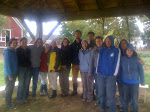
The Lucky Thirteen
Monday, January 31, 2011


Saturday, January 29, 2011
My Review of Cat Flap
Originally submitted at PetSafe

Give your cat access to her litter box without giving her litter box access to your home! This durable cat flap fits any interior door that’s 1” to 2” (2.5 cm - 5 cm) thick. Your cat can come and go from the room where her litter box is housed – even when the door is clos...
Pretty and Pretty difficult to install
By Lee from Maggie's Farm on 1/29/2011
Pros: Good looking
Cons: Poor quality fastener, Directions ambiguous, Difficult to Install
Best Uses: Cats
Describe Yourself: Long-time Pet Owner
Installed this cat flap on a farmhouse door. Previous models had more specific directions, a template for the cutting line, and a back that screws on. This one has little sticky tabs to attach the back. I doubt it will stay together but I installed it anyway now that I have a hole in the door!
(legalese)
Friday, January 28, 2011
Business planning and Raising the first "bents" of the timber frame
This morning we discussed further the elegance and frustration of writing a business plan. Again, we used Nate and Jen's farm plan as the starting point for our questions, going through their proposals and financial documents. This got me thinking about the nature of farming as a business. It is one thing when a new gadget maker runs into trouble and his business folds--no job for him and no gadget for us. Farmers, however, are supplying our food and it was good to know there is support for them: reduced costs in vehicle insurance, utilities, lower land taxes are just a few things we do to make farming work as a business. Wm offered us an article on the "the food movement" which I have read most of and highly recommend to you, too. There is a little blurb about the farm crisis in the 1980's which I remember but had no idea it was related to the federal government focusing its price supports to corn and soy.
Here's the article: http://www.nybooks.com/articles/archives/2010/jun/10/food-movement-rising/
Our afternoon was also elegance and frustration--and some progress. We set about raising the first section of our timber frame sawmill shed. See it and cheer!

Stay tuned for the rest of the building. First, however, is a change of venue. We head for Italy early next week.
Here's the article: http://www.nybooks.com/articles/archives/2010/jun/10/food-movement-rising/
Our afternoon was also elegance and frustration--and some progress. We set about raising the first section of our timber frame sawmill shed. See it and cheer!
 |
| Sophia trims the brace tenon while Brian hangs on |
 |
| Kiyoshi and Emma check the brace |
 |
| Josh helps us see the whole picture before heading out |

We began by hearing the "big picture" from Josh. We had our two "bents" which are upright posts and their top plates. We also had two tie beams that join the bents from front to back and the braces needed to fit together. We checked the fittings to make sure that the mortices and tenons were matched. Once the pieces were ready, we loaded up the horse cart and set off for the mill site.
 |
| The crew |
 |
| Me, carrying an oak brace--wow, it is heavy |
 |
| The whole crew carrying the north bent |
Then we began the death-defying feat of setting these very large pieces of wood vertical. By golly, it worked! Eventually...
 |
| Lifting the bent. |
 |
| Getting the tie-beam in place |
 |
| Stand back and LOOK! |
Stay tuned for the rest of the building. First, however, is a change of venue. We head for Italy early next week.
Andiamo in Italia!
Thursday, January 27, 2011
How I spent my Thursday
I went to bed last night feeling pretty low. Still felt that way today. So I read and dozed and dozed and read. Got a little bored not to mention jealous of my fellow farmers--finishing up the timber frame, working on their fiber projects. So, to pass the time, I began working on a chart of pasture forage.
There are three main types plants that our cows and sheep eat--grasses, legumes and forbs. This chart isn't complete but it has certainly helped me to start to begin to commence to understand what it is that soaks up the sun, takes a four-stomach journey and ends up as milk or meat for us to eat.
The images didn't copy well. The important information is the content upon which I am still... ruminating (sorry, could NOT resist that pun.).
| Name of grass | Image | Sci-name | Bunch or sod | Low med hi | Important info |
|---|---|---|---|---|---|
| Orchard grass |  | Dactylis glomerata | bunch | med | Ratio of digestible/undigestible 1:1 |
| Perrenial rye grass | | Lolium perenne | bunch | low | Ratio of digestible/undigestible 4:1 |
| Tall fescue | | Festuca arundinacea | bunch | tall | |
| timothy | | Phleum pratense | bunch | med | |
| Kentucky bluegrass | | Poa pratensis | | low | |
| Smooth bromegrass | | Bromus inermis | sod | tall | |
| Reed canarygrass | | Phalaris arundinacea | | tall | |
| quackgrass | | Elytrigia repens | sod | med | |
| Canada bluegrass | | Poa compressa | | | Confused with Kentucky bluegrass, cuts gums –improve fertility to grow Kentucky |
| Meadow fescue | | Festuca pratensis | bunch | med | Gorws with timothy, wet soils, close grazing and lax grazing OK |
Need to have 30 to 50% legume GROWING IN PASTURE
| Name of Legume | Image | Sci-name | | details |
|---|---|---|---|---|
| White clover | | Trifolium repens | | Grows low to ground, via stolons, shallow rooted |
| Red clover | | Trifolium pratense | | Deeply rooted, upright grow, good with tall grasses, lives only two years |
| alfalfa | | Medicago satvia | | With bromegrass and canary grass, withstand drought |
| Birdsfoot trefoil | | Lotus corniculatus | | Can grow on poor soil, tricky to grow, |
| vetch | | | | Viny legume |
| | | | | |
Animals love forbs, we call them weeds, edible at early stages
| Name of forb | Image | Sci-name | notes |
| plantain | | Plantago major | |
| dandelion | | taraxacum | |
| chicory | | | |
Wednesday, January 26, 2011
Biodynamics and garden planning
Carlen led our discussion of biodynamic farming this morning, helping us to understand a bit more about this "farm as an organism" apporach to growing food. Since I'm still clarifying in my mind what this means, I'm going to snip out a piece of Wikipedia to share with y'all.
Biodynamic agriculture is a method of organic farming that treats farms as unified and individual organisms,[1]emphasizing balancing the holistic development and interrelationship of the soil, plants, animals as a self-nourishing system without external inputs[2] insofar as this is possible given the loss of nutrients due to the export of food.[3]
Regarded by some as the first modern ecological farming system[4] and one of the most sustainable,[5] biodynamic farming has much in common with other organic approaches, such as emphasizing the use of manures and compostsand excluding of the use of artificial chemicals on soil and plants. Methods unique to the biodynamic approach include the use of fermented herbal and mineral preparations as compost additives and field sprays and the use of an astronomical sowing and planting calendar.[6] Biodynamics originated out of the work of Rudolf Steiner, the founder ofanthroposophy.
In comparing biodynamics with organic farming, each system has requirements to do and to NOT do. Both are aiming to support plant growth by providing an "ecological system." The tricky parts about comparing these two systems are first, I don't know much about the specifics of the biodynamic practices and second, the practices prescribed by organic farming now relates to minimal standards, which most organic farmers exceed.
Sorry, that's all I have for today. Not feeling that great. I do have some beautiful, iced farm photos. Enjoy!
 |
| Looking South from Maggie's Farm |
 |
| Iced fruit on the branch |
 |
| Out the barn towards the "horse bus stop" |
Tuesday, January 25, 2011
Talking Tuesday
This morning, we completed our crop-planning sequence with Nate. I feel confident that if I had a CSA and some land and some soil amendments and the right seeds, I could lay out a crop plan, a greenhouse schedule and estimate what I will spend and what I might make. All the work in between the planning and the making is still a bit fuzzy. I look forward to making that middle piece--the action piece--come alive on the farm.

In the afternoon, we enjoyed a visit from Deb Habib of "Seeds of Solidarity" farm and educational organization.
Our evening was blessed with a sweat lodge ceremony led by Andrew. What a wonderful experience!

In the afternoon, we enjoyed a visit from Deb Habib of "Seeds of Solidarity" farm and educational organization.
Our evening was blessed with a sweat lodge ceremony led by Andrew. What a wonderful experience!
 |
| Snow melting away from the fire |
 |
| Caitlin Brian and Justin, preparing for the sweat |
 |
| Sophia Rebekah and Andrew watch the fire |
Monday, January 24, 2011
Tool sharpening and Planning the garden
We had a lovely adventure at the NOFA-NY conference this weekend which included sessions on many different aspects of farming, lovely meals, seeing Air Force One (or getting stuck in the presidential traffic) and in general enjoying the company of farmers. Here are a few shots from this past weekend:
Our group started off the week with Carlen. After discussing the parts of tools and describing their upkeep, Carlen led us in brushing off, filing and oiling our garden tools. The sound was reminiscent of a tough day at the Dentist office mixed with the sounds of chalk scraping the chalk board. Not pretty on the ears but the result of shiny tools was delightful.
Our afternoon session began with each of us sharing our experiences at the Nofa conference. After that was complete, we started in on our garden planning with Carlen. We discussed the parameters of our garden planning--how to divide up the work, how to choose plants, how to design beds and we decided to see the scope of our wishes as we begin to plan. We'll meet with Carlen again on Wednesday with a group list of desired plants for our homestead garden.
 |
| Sophia, Emily and Emma |
 |
| Icy sunrise at Saratoga Springs, NY |
 |
| Andrew, Just and Theo |
 |
| Kiyoshi and Caitlin |
 |
| Rebekah, Betsy and Nora |
 |
| Carlen and Brian looking at 'the edge" |
 |
| Sophia and the garden fork |
 |
| Kiyoshi "brightening up" a shovel |
Our afternoon session began with each of us sharing our experiences at the Nofa conference. After that was complete, we started in on our garden planning with Carlen. We discussed the parameters of our garden planning--how to divide up the work, how to choose plants, how to design beds and we decided to see the scope of our wishes as we begin to plan. We'll meet with Carlen again on Wednesday with a group list of desired plants for our homestead garden.
Subscribe to:
Posts (Atom)